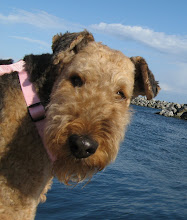
Consult with Internist and Oncologist
Hi Everyone, mum taking over. Prepare yourself for loooooooooong and booooooooring..... so sorry...
Love nibbles to all,
Miss Sunshade
*********************************************************
By Sunshade's mum
I took Sunshade down to Seattle on Wednesday, December 1st to see an Internist for her raging Cushing's Disease, as well as an Oncologist for her Soft Tissue Sarcoma. Kathy, a long time blog friend (mother of Jemma the Chihuahua Princess) so graciously offered to come with me for moral support, and back up in case I blank out during the consult. I have been doing things like putting both contact lenses into the same eye, and paying the cashier $40 at the gas station and then driving away without putting any gas in. So blanking out is not out of the norm for me these days. Derek stayed behind to work and look after my Jaffaman!
Many people have asked me why I have chosen to take Sunshade down to Seattle instead of going to our local specialists clinic 20 minutes away. The short answer is I have had one bad experience with them with Sunshade's first orthopedic surgery in 2001, and have heard many unpleasant stories involving them. The other short answer is I have had nothing but good experiences with specialists from three different specialty clinics in Seattle. I personally feel the veterinary expertise and bedside manner in the States are far more superior than most specialists here in British Columbia. Sunshade deserves nothing but the best.
*************************************
Cushing's Disease
Our first appointment was with Dr. Matt Vaughan at the Seattle Veterinary Specialists to discuss treatment options for Cushing's disease.
If you remember from our posts before, we were trying to avoid the use of the drugs commonly used to treat Cushings disease due to their potentially deadly side effects. However, we have tried the holistic approach to no avail, and now we need the help of conventional medicine to stop the physical deterioration, as well as the personality changes seen in Sunshade resulted from the uncontrolled Cushing's Disease. (Sunshade: mum says I'm not a b*tch anymore and don't like my beach walks.... What's a b*tch? ) (mum: Go ask Jaffa!)
I had chosen Dr. Vaughan as our Internist because through my research, I found out he had a special interest in endocrinology and spent much of his residency involved in research projects focused on canine Cushing’s disease and Diabetes Mellitus. I was delighted to hear that he was on the UC Davis research team that came up with the latest Cushing's treatment protocol that vets/specialists from all over the world are following. Not only was Dr. Vaughan very knowledgeable, he was also extremely genuine. He listened to my every concern, answered all my questions and came up with a treatment plan for Sunshade.
Don't get me wrong, I am still very wary of starting Sunshade on Trilostane (our chosen drug). However, I do feel much better and much more confident to have an experienced specialist on board with us.
Dr. Vaughan might have sensed my worries, as he wrote me a follow up e-mail that evening to basically reiterate what was said during the consult. To me, this shows a specialist who really cares, and is willing to work and communicate with general vets/owners.
Below is Dr. Vaughan's e-mail as well as his report to Dr. Crook (most of you know her as Auntie Janice LOL...),
Hello Elaine,
It was a pleasure to meet you and Sunshade today, hope you made it home OK.
The trilostane will be started at 30mg twice daily and a recheck ACTH stim test is recommended 1-2 weeks after starting therapy. This test needs to be started 3-4 hours after the morning trilostane dose is given (this is the "peak effect" time). The effectiveness of trilostane is based upon test results, but more importantly on resolution of her symptoms. Please keep an eye on these symptoms (thirst, urination, appetite, energy level) as I will be asking you how they compare to pre-treatment levels.
Things to watch for that would indicate too MUCH trilostane would be a lack of appetite, vomiting, diarrhea, lethargy or collapse. If you note any of these signs, stop giving any more trilostane and if possible have an ACTH stim test performed ASAP. Prednisone can be started at 10mg twice daily if she is very sick, however stopping trilostane is usually enough.
As we discussed, the starting dose of trilostane is fairly low (1 mg/kg twice daily) and will most likely need to be increased. We also need ot make sure that her signs are not actually worsening on the trilostane and if so the plan would be to switch to Lysodren.
Please don't hesitate to contact me by phone or email if you have any questions or concerns regarding Sunshade or if you have any problems obtaining a prescription of trilostane. I have copied a letter to Dr. Crook below for your records.
Take care,
Matt
Dear Dr. Crook,
I saw Sunshade today for evaluation of Cushing’s disease. I did review the recent thoracic radiographs with our radiologist and found no significant changes.
The recent low dose dexamethasone suppression test results and ultrasound findings are consistent with pituitary dependant hyperadrenocorticism. It may be that this began as an increase in cortisol precursors/sex hormones and progressed to involve cortisol, however 40% of dogs with Cushings will have normal cortisol levels on an ACTH stimulation test and so it is possible that this is a variation of "typical" hyperadrenocorticism.
Medical treatment options for the hyperadrenocorticism would include either Lysodren or trilostane. Theoretically, trilostane should (and does) increase some cortisol pre-cursors which can worsen atypical hyperadrenocorticism. That being said, I have had a number of cases that did respond clinically to trilostane despite this. I am also not convinced that this is truly "atypical" hyperadrenocorticism and so I think that a trial of trilostane would be reasonable.
The depressed activity level may be due to elevated cortisol levels or could potentially be related to a pituitary macrotumor. The stumbling may be related to a pituitary mass, however the duration of stumbling signs is quite long (over 1 year) and it would be unusual to not see a more rapid progression of signs if these signs were due to a macrotumor. An MRI could be considered to evaluate the pituitary gland and a recheck neuro consult would be recommended prior to proceeding with an MRI.
The soft tissue sarcoma was not discussed in detail today as there is a pending appointment with an oncologist. I did recommend that if radiation therapy for the sarcoma is considered, an MRI of the brain might be a good idea as a pituitary mass could potentially also benefit from radiation.
The plan is to start trilostane at 30 mg PO BID. This is a relatively low dose and the goal is to slowly increase the dose based upon clinical signs and ACTH stim results (cortisol-only is sufficient). The goal is resolution of clinical signs and a post-stim cortisol between 1-5. An ACTH stim test is recommended 1-2 weeks after starting therapy as well as 1-2 weeks after any dose change. Timing of the ACTH stim test is critical and should be performed 3-4 hours after the morning dose of trilostane. I am more than happy to continue to help with interpretations of lab results and dosage changes if you fax test results to me.
Thank you for the referral. Please let me know if you have any questions or concerns regarding this case.
Sincerely,
Matt Vaughan, DVM, DACVIM
We plan on starting Sunshade on Trilostane on a Sunday. According to Dr. Vaughan, we'd probably see a response before the end of the week and can test during regular veterinary operation days if necessary.
*******************************************
Cancer - Soft Tissue Sarcoma
Our next appointment was with Dr. Bob Rosenthal at the Animal Cancer Specialists. I had heard many good things about the clinic and Dr. Kari Meleo, the founder of ACC. Unfortunately, she books 3 months in advance. Dr. Rosenthal was new at the cancer center, but not new at practicing oncology and I was very pleased with our appointment.
Just a recap:
November 10th, 2010: jelly bean sized lump removed under local anesthetic from left thoracic region. Biopsy showed Grade 1 Soft Tissue Sarcoma (low mitotic index)
November 17th, 2010: marginal surgery - 3cm X 3 cm skin around the tumour site removed along with some adjacent fat tissue. Pathology showed one plane did not achieve wide margin, all other margins were clear.
I will put the summary of our consult in Q & A format:
Q: Does a successful "clean margin" surgery eliminate the possibility of recurrence?
A: No, clean margin doesn't guarantee no recurrence as we are talking about microscopic level. There will be some residual cancer cells left at the microscopic level.
Q: Does a clean margin surgery reduce the probability of a recurrence?
A: Having a clean margin does technically reduce the recurrence rate by a bit, because you are leaving less cancer cells in. However, it doesn't make a huge difference.
(The answer above was very specific to Sunshade's particular type and grading of the tumour, as well as the fact that all of the margins were clean except one plane. I'm sure the answer would be different if we were talking about a Grade 3 Mast Cell Tumour.)
Q: What is the best method for getting rid of all cancer cells?
A: Radiation is best option to clean up at the microscopic level. The location of Sunshade's tumour site makes it possible to have full range/spectrum radiation without damaging major organs.
Q: How likely is it for Soft Tissue Sarcomas to recur?
A: Recurrence rate to the same site is high due to the locally aggressive nature of this type of tumour. However, the timing for at which a recurrence may happen varies anywhere from 10 days after surgery to months, to years depending on each individual tumour. He told me it is unlikely for Sunshade's particular tumour to return soon given its low mitotic index.
(Janice also talked to the two pathologists that worked on the tissue from the marginal surgery. They gave her an estimate of recurrence at 3-4 years with the dirty margin. Sunshade is 11 right now, 14-15 is very good for an Airedale if I'm being realistic.)
Q: Would the tumour be harder to remove should there be a recurrence?
A: The surgical procedure would yield a bigger wound and the patching job would be a bit tougher as we would be removing yet more skin. However, the removal of the tumour itself should not be more difficult.
Q: If radiation is held off this time around, would future radiation be less effective should the tumour return?
A: Doing radiation the second time around is JUST AS successful as if radiation were performed the first time. It will NOT be less effective at killing the cancer cells.
(Very comforting to learn that.)
Q: Should I choose to have a second margin surgery done, would having a board certified surgeon perform the surgery lead to a higher success rate?
A: The success rate is usually a little higher with board certified surgeons because they tend to be more aggressive. However, it doesn't mean that a general vet practitioner can't be as aggressive.
(He said from the looks of Sunshade's scar, he thought we were being pretty aggressive already given that the tumour was only the size of a jelly bean. So he was sure that the same vet would be just as aggressive with the second surgery.)
In conclusion, Dr. Rosenthal felt that given the type (low metastatic rate, recur at same location) and grading of Sunshade's tumour, radiation is not urgent. While he would recommend radiation for a young dog/healthy dog, he believes Sunshade's Cushing's disease should take priority for now. Great to see an oncologist who is able to look that the whole picture!
*******************************************
My plan right now is to treat the Cushings, and "maybe" do a second margin surgery given that we know where the dirty margin is (which we think we do as Janice marked the tissue sent in with sutures). I will not pursue radiation for now.
Again, I can't say enough good things about the following specialty centers in Seattle. I would highly recommend them to anyone in WA and Western Canada.
- Animal Surgical Clinic of Seattle (Sunshade's TPLO knee surgeries were done there - great success)
- Seattle Veterinary Specialists (Sunshade's neurology & internal med consultations)
- Animal Cancer Specialists (Sunshade's Soft Tissue Sarcoma consultation)
Please continue to keep Miss Sunshade in your thoughts, and cross your fingers (and paws) that we don't run into complications with Cushing's treatment.
Thank you again for being in on the ride with us, you have helped "me" more than words can describe!! I feel so much better now that we have a plan and Sunshade can start getting better. I slept for more than 5 hours last night for the first time in the last 3 weeks. Actually, I slept for 12 hours!
Ear scratches to all your fur-kids,
Sunshade's mum